To give you an idea of a typical day
here I'll just take you through the events of yesterday. OK, it
wasn't exactly a typical day, but it will give you an idea of some of
our challenges.
I awoke at 5:30, before sunup. Living
at 1 degree south latitude, the sun comes up unbelievably fast
because it basically crosses the horizon at a right angle. At 5:50
it's pitch black. At 6:00 you can read a book outside. At 6:10 it's
daylight. I tried to make coffee, eat something, read my Bible, and
exercise before my planned departure for Musoma at 7:00. Both the
kids got up at 6:00, so I only succeeded at the coffee and ten
minutes with the Bible. When “Baba” ('Father' to all
the orphans, a pastor, and quickly becoming a close friend) knocked
on my door at 7:10, I lamented, “Is it 7:00 already?!” I'm not
sure how exactly how I passed that hour and a half, but the kids
certainly had something to do with it. So I grabbed a plastic cup of
coffee and hunk of coffee cake (a rare treat somehow fortuitously
left over from the day before), and jumped in the van, remembering to
take some plumbing parts, some money, a shopping list, and some
documents I had prepared for the government.
Realizing that our badly rutted road is
no place for a lidless cup of coffee, I chugged it as the van warmed
up. The van more or less refused to go into gear. As we hurried out
the gate, Baba grabbed our mechanic and said, “You're coming
with us. I don't trust this van.” Shortly thereafter Baba
gave up fighting with the surly clutch, and pulled over. “Zacharia,
you drive this thing,” he muttered. Along the way I began making
phone calls to arrange a second opinion on our clutch situation from
a trusted mechanic in Musoma, and trying to do it in a way that
Zacharia didn't feel insulted. At least if I was watching him
actually choosing to climb steep hills in fourth gear because
downshifting was likely to be such a struggle, then he couldn't
reasonably insist that there was no serious problem.
After 30 minutes of dust, ruts, bumps,
and gears grinding, we reached the pavement. I didn't realize that I
had forgotten my passport until we passed through perhaps the fourth
police checkpoint of the morning about an hour later. Here's a
little backstory: Musoma is the regional capital. We were going
there to discuss opening the hospital with the authorities. The
truth is that though we had expected to, we hadn't heard from them in
a week, so we decided to conveniently be “in the area,” so that
we could “just stop in to greet them.” Just two weeks ago we
were there on the same errand. That day I had not brought my
passport because I honestly didn't think it was necessary—we were
not crossing any borders. But that day I learned that immigration
officers stop all foreigners (and I'm very obviously a foreigner),
and ask to see their papers. Apparently you can be arrested for not
having them. I wasn't arrested that day partly because I pled
ignorance, but more because I was with our director, who simply called
his compatriots at the immigration office who told the enthusiastic
young officers to back off Dr. C's friend.
But yesterday, as we pulled up to the
checkpoint, I wished our director were there, because I realized that
though now I was no longer ignorant, I had forgotten my passport in
my rush to get out the door. I slunk down in my seat. Worse yet, it was the same enthusiastic servicemen who had
stopped me in town before. They were very insulted that I had not
heeded their week-old warning. What followed was about an hour of
animated pleading and negotiating on the part of Baba, which I
understood little of. My Swahili is about at the point that if
someone gauges my ability correctly and then chooses to make
themselves understood, then I can generally follow them. But if they
don't want to be understood, they can very easily talk over my head.
I tried very hard not to be, or to appear, indignant. After all, I'm
here to help, I'm not getting anything material in return, and I'm
not doing anything illegal or unethical. I simply forgot my papers.
What is more, they knew that I actually have the proper papers
because their supervisor had told them that on the phone just one
week before—He actually issued them himself. Perhaps I could have
reasoned with them, but both my cultural acumen as well as my
language skills are sorely wanting. So I left that to Baba.
Also, I realized that my being indignant was nothing more than pride,
and really their modus operandi was simply feigned indignancy. It
would have been easy for this to turned into a contest of wills.
They really just wanted a little money to buy breakfast. The truth
is that is how they make their living. I decided not to allow my
pride to enter the arena, giving their pride no combatant to wrangle
with.
I followed enough of the tete-a-tete to
understand that Baba played the following cards: “I'm a
pastor,” “You know me,” “Your boss knows me,” “Your boss
knows Dr. C,” “I'm a good Christian,” “We are just
trying to help the children,” “You know he has the papers because
you checked with your boss last week,” and “He is just here to
help.” But the officers would not relent. They insisted that the
letter of the law is that you must carry your papers wherever you go.
The truth is it's all about who you know, but yesterday dropping Dr.
C's name was not enough. Often relationships supersede the
letter of the law, but when it's to an officials advantage to insist
upon the letter of the law, they certainly will do so.
In the end Baba took me aside
and explained with an ironic and placating smile, “They say, 'All
those things you said are true, but what about us? We haven't had
breakfast. Give us something for chai and chapatis.'” It was in
fact tea time (10:00AM), and conveniently they had picked the only
tea shop on miles of uninhabited road as the appointed position for
their stake out. It turns out Baba had already offered them
10,000 Tanzanian shillings but they refused. They wanted 20,000
(twelve dollars).
Here came my pride again. Indignancy
rose in my gorge like bile. Luckily Baba had been wise enough
to hide me behind the van for this discussion. I thought, “I don't
care about the twelve dollars! That's nothing to me. That's less
than coffee and a sandwich in the airport! Who do these guys think they are insisting on the letter of
the law? What about the law that says that bribes are illegal!?”
I didn't say all this. I think I said a little of it. Clearly
Baba read it in my eyes. I think I used the word bribe very
quietly, which made Baba wince a little. I retreated to
relying on Baba's wisdom and character. I asked, “Do you
think it's OK for us to pay them?” He knows enough about Americans
to know that I don't care about twelve dollars compared to standing
in the blazing sun arguing over trifles. He understood exactly what
I was really asking: “Is it morally OK to give these jokers bribe
money?”
This is a fairly common debate amongst
missionaries. Do you pay the bribe? Usually to the cops. To pay is
to invite-no encourage-recurrence. And certainly there is a moral
dilemma. To not pay is to face untold hassles. In my opinion, there
is no clear answer to this dilemma, and you must always consider both
how much time you have and what the foreseen hassles may be. In the
end, it usually comes down to this: the person who wants the bribe
probably has more time on his hands than you do. Are you going to
wait him out over twelve dollars. Time has value—a lot of value.
Would you rather he took two hours of your time or twelve of your
dollars, because he's going to get one of them.
As I mulled this over, asking the Lord
for a little guidance, I was reminded of a close friend and seasoned
missionary laughing as he told a story about being hassled by a
traffic cop in Ecuador. He guffawed, “You just pay it!”
This recollection was comforting, and I
had to admit that I had in fact made a mistake in forgetting my
passport. Baba's answer was a palliative, “I think it's OK.
I don't mind to pay them.” So I sheepishly forked over the two
bills to the head officer, whose demeanor significantly improved
as soon as I reached for my wallet.
As the men sauntered over the to chai
house en masse, to allow who knows how many genuine felons to pass
the roadblock unmolested for the next hour and half, Baba had
the mettle to petition them: “What about me? I haven't had my chai
yet either. We've been on the road for three hours. Buy me a
chapati!” He was serious. This goes to show how much I do not yet
understand about this culture. He did walk away with a chapati. He
even offered me half of it. I was too flabbergasted to ask who had
paid for it.
We stopped at a demonstration farm
outside Musoma because I was interested. We have six acres of land
to plant and landscape at the hospital and I want it to be a
demonstration farm as well as a healthful and beautiful environment.
Whenever I explain this to people here they agree, but that still
doesn't keep the orphans from totally mauling what flowerbeds there
are at every opportunity. Everything grows vibrantly here. We enjoy
copious wildflowers. But the kids seem to be utilitarians when it
comes to plant life. If they can't eat it, then they don't see any
value in cultivating it. Often a horde of kids will pass by the
flowers in front of our house thoughtlessly stripping the blooms and
leaving them strewn on the ground in a trail of rubbish. My strategy
for this is as follows: Through their caretakers, I intend to enlist
their labor in planting and pruning flowers at the hospital. Perhaps
through some sweat and blisters they will learn to let the flowerbeds
be. We will see.
Zacharia and I share an enthusiasm for
growing things. We collected both seeds and ideas for the planting
program at the hospital. We would have liked to spend the whole day
there, but more pressing business intervened.
Ten minutes later we dropped Zacharia
and the van at the mechanic's shop and took a taxi to the government
offices. They greeted us heartily, said they intended to provide us
with some workers and supplies, and sent us on our way to see other
officials. The short version of that long story of official
discussions is this: Eventually it came out that there are certain
forms that must be filled out in order to register a hospital with
the government, and these forms must be sent to the Ministry of
Health in Dar es Salaam. This was perhaps the seventh long meeting I
have had with government officials over one month—all with the goal
of obtaining registration for the hospital. Now why hadn't someone
told me about these forms before? We wasted way too much time going
to and fro, waiting outside one government office then another.
It was three o'clock before we had
threaded our way through the catacombs of government meetings in
Musoma. Along the way, we met a missionary friend who had just that
morning taken a bus to Musoma. But the one hour ride had taken three
and a half hours because the bus kept breaking down. She was in no
mood for a repeat performance. We agreed to give her a ride home.
We returned to pick up the van to find that the mechanic had fixed it
for free. “I've just bought some tomatoes, and onions, and bananas
for the children,” he said. We were all shocked but thanked him
warmly and headed out.
About an hour later we were stopped at
another roadblock. This time the police insisted on seeing Zacharia's
driver's license. He has one, but it's Kenyan. And when they saw
that is was Kenyan he knew that they would start hassling him about
why he didn't have his passport. There's no need to repeat all the details of the above
story again. Suffice it to say that Baba spent another half
an hour in similar negotiations, resulting in a smaller bribe but no
chapati.
It was already five by the time we
started our shopping errands in several locations just before the
pavement ends on the way home. At one point we parked right in front
of the immigration office at the border while Baba walked
through the gates to buy some Kenyan specialty on the other side. As
we pulled up, the place swarming with uniformed immigration police
looking like they had nothing better to do than try to squeeze
shillings out of some unsuspecting white boy, I told Baba,
“You know I don't have my passport, right?”
He laughed, “Oh these are our
friends,” as he got out of the car and disappeared. I wasn't so
sure. I hunkered down in my seat and tried to look inconspicuous for
the next half an hour. After that we squandered more time waiting
for a merchant from whom we had recently purchased fruit down the
road. He kept calling on the phone insisting that he was “only
five minutes away,” for half an hour. The sun was setting. I
insisted we just head out. We endured a little more dust and ruts
and finally arrived home, trail-worn but safe, into the arms of our
expectant families. Everyone wanted to know what had delayed us. I
answered flatly, “Government officials,” and this was a
sufficient answer for all who heard.
Monday, February 6, 2012

Sunday, February 5, 2012
Dr. Plumber
Some funny things that have happened
lately.
We have been without a working sink or flushing toilets for a month. The well pump was fixed last week, but when we turned on the water to the house, many of the sinks and toilets still didn't work. Pretty disappointing. Between diapering, and attending to boils on kids, and welding, and working in the garden, I want to wash my hands pretty often. To be without a sink is a hassle. It's hard to feel like you really got the germs off.
An interesting cultural phenomenon here: Ntagatchans will talk to each other from ridiculously far apart—and at normal volume levels. It seems they have superhuman hearing. I've seen people talk to each other from 100 yards apart without raising their voices. Partly this is possible because it's so quiet here (very very few motors). And partly, I think, it's because in this hierarchical society, it's assumed that a lower person will always greet a higher person, and this it's the lower person's responsibility to make themselves heard. And, the lower person will intentionally stand quite far away—even twenty feet—on purpose. This is considered polite and submissive. The higher person can be as soft spoken as they choose. Also it's important that the lower person not be too loud, lest they be perceived as asserting themselves too much. The resultant effect for me is that in general people speak to me in a tone which is much to quiet for me to discern the nuances of a foreign language. I am constantly asking people to repeat themselves.
Believe me, when one is learning a language, not being able to hear your interlocutor (or read their lips) is an extreme disadvantage. When they talk to me from twenty yards away I just walk over to them. Or I just repeat “nzuri,” (fine) and “sawa” (OK) asseems appopriate until they stop. I don't know what else to do.
Yesterday I witnessed a funny example of this distance-talking. We let the manager know about the sink problem. At the time he was sitting nearby a water cistern, a 50,000 gallon underground concrete tank. The cistern is undergoing repairs so there were two men down inside it—way down inside it. Without getting up to walk to the access hatch of the tank (he was sitting about twenty feet away), the manager began having a conversation with one of the guys at the bottom of the tank. They simply began shouting back and forth to each other, the voice of the man in the bottom echoing sonorously. The conversation being held in a pigeon of English, Swahili, and Kuria, it was all the more incomprehensible to me. It was ridiculous! “Nanyo, who do you know who is a plumber?” Reply: “There's one working up at the hospital right now.” “Perfect!” And so it went. How they could understand each other I have no idea. Eventually someone took it upon himself to act as an interpreter, squatting at the top of the hole and shouting each sentence back and forth.
Unfortunately, the plumber is less skilled than I am at plumbing. So he didn't make much progress on the sink. His first suggestion was that we completely replace the entire plumbing system. Using this tack he wouldn't have to search out the problem and he would have plenty of income from a big job; this building has at least six bathrooms. Irritated with his advice, I decided to find the problem myself. That only took about ten minutes—it was a stuck valve on one of the pipes outside. When I fixed it, one whole bathroom and the kitchen began working. Rarely have I received such a hero's welcome as when I strutted into the kitchen to the sound of water gushing from the tap (pipe wrench in hand, so they would know it was me). Restoration of running water is a big victory around here.
As it turns out, the plumber isn't so bad as long as you tell him exactly what you want done. He is replacing the faucet on our bathroom sink right now. Hopefully we are just minutes from being able to wash our hands easily!
We have been without a working sink or flushing toilets for a month. The well pump was fixed last week, but when we turned on the water to the house, many of the sinks and toilets still didn't work. Pretty disappointing. Between diapering, and attending to boils on kids, and welding, and working in the garden, I want to wash my hands pretty often. To be without a sink is a hassle. It's hard to feel like you really got the germs off.
An interesting cultural phenomenon here: Ntagatchans will talk to each other from ridiculously far apart—and at normal volume levels. It seems they have superhuman hearing. I've seen people talk to each other from 100 yards apart without raising their voices. Partly this is possible because it's so quiet here (very very few motors). And partly, I think, it's because in this hierarchical society, it's assumed that a lower person will always greet a higher person, and this it's the lower person's responsibility to make themselves heard. And, the lower person will intentionally stand quite far away—even twenty feet—on purpose. This is considered polite and submissive. The higher person can be as soft spoken as they choose. Also it's important that the lower person not be too loud, lest they be perceived as asserting themselves too much. The resultant effect for me is that in general people speak to me in a tone which is much to quiet for me to discern the nuances of a foreign language. I am constantly asking people to repeat themselves.
Believe me, when one is learning a language, not being able to hear your interlocutor (or read their lips) is an extreme disadvantage. When they talk to me from twenty yards away I just walk over to them. Or I just repeat “nzuri,” (fine) and “sawa” (OK) asseems appopriate until they stop. I don't know what else to do.
Yesterday I witnessed a funny example of this distance-talking. We let the manager know about the sink problem. At the time he was sitting nearby a water cistern, a 50,000 gallon underground concrete tank. The cistern is undergoing repairs so there were two men down inside it—way down inside it. Without getting up to walk to the access hatch of the tank (he was sitting about twenty feet away), the manager began having a conversation with one of the guys at the bottom of the tank. They simply began shouting back and forth to each other, the voice of the man in the bottom echoing sonorously. The conversation being held in a pigeon of English, Swahili, and Kuria, it was all the more incomprehensible to me. It was ridiculous! “Nanyo, who do you know who is a plumber?” Reply: “There's one working up at the hospital right now.” “Perfect!” And so it went. How they could understand each other I have no idea. Eventually someone took it upon himself to act as an interpreter, squatting at the top of the hole and shouting each sentence back and forth.
Unfortunately, the plumber is less skilled than I am at plumbing. So he didn't make much progress on the sink. His first suggestion was that we completely replace the entire plumbing system. Using this tack he wouldn't have to search out the problem and he would have plenty of income from a big job; this building has at least six bathrooms. Irritated with his advice, I decided to find the problem myself. That only took about ten minutes—it was a stuck valve on one of the pipes outside. When I fixed it, one whole bathroom and the kitchen began working. Rarely have I received such a hero's welcome as when I strutted into the kitchen to the sound of water gushing from the tap (pipe wrench in hand, so they would know it was me). Restoration of running water is a big victory around here.
As it turns out, the plumber isn't so bad as long as you tell him exactly what you want done. He is replacing the faucet on our bathroom sink right now. Hopefully we are just minutes from being able to wash our hands easily!
Tuesday, January 31, 2012
HAPPY 4th BIRTHDAY LITTLE T!!!
Happy Birthday, t. We are so happy to be able to celebrate another year of your life with you. You are a treasure. You are smart, funny, creative, mischevious, delightful, sensitive, expressive and a true delight. We love you more than we ever dared hope or dream. We thank God for you every day and we are so greateful that you have been given to us to love and cherish. Happy Birthday!!!
.jpg)
.jpg)
.jpg)
t's only complaint was heard after celebrating. “Mommy, I still can't read!” Much disappointment came upon realizing that despite his advanced age, he is still yet unable to read.
Thursday, January 26, 2012
The Futility of Man
.jpg)
I knew from the beginning that I'm not really up to the task—that if it is to get done then God will have to do it. But now I'm really experiencing the futility of man. There is so much more to do than I can do myself. Even with a large team (which I do not have at this point) I would still be overwhelmed with the enormity of the task. Even just making my to do list is a big job.
I am encouraged this morning by one of those psalms that can seem so depressing at times. (Don't worry, I'm not depressed—just daunted). In Psalm 89: 47-48 the psalmist addresses the Father:
"Remember how short my life is; remember that you created all of us mortal!
Who can live and never die? How can
human beings keep themselves from the grave?"
I identify with that this morning. I don't have enough days in my life (not to mention energy or freedom from distraction) to get done what needs to be done. One of my main tasks is to recruit and train workers for hospital, but so far I have only found one and we haven't really done any training yet. But the slow progress in that department brings me to an important point:
Ministry is about people, not progress
or projects. People embody eternal souls. In a hundred or so years,
both this hospital and this children's home will mostly likely be
rubble. But these staff, these patients, and these children will
still exist (albeit in different material circumstances). My task
here is much bigger than just the practical nuts and bolts of getting
a hospital up and running. I'm actively trying to be people-focused
instead of institution-focused. I am especially focused on mentoring
the hospital staff. This is about investing in the destiny of eternal
souls—children of God created in His own image! Has he entrusted
me with such tremendous responsibility? Indeed he has. When I think
of that: talk about coming up hard against the futility of man!
I am NOT up to that task! But I am
reminded that all He requires of me, He provides. The work is not
mine but His. Really I'm just along for the ride—for how He will
use the journey to shape my life and my family and for other reasons
that I cannot hope to see. But He does.
In the remainder of Psalm 89, the
psalmist, after lamenting his impotence, in effect reminds God:
“Don't forget who you are!” Like Abraham pleading on behalf of a
few hypothetical righteous Sodomites, like Habakkuk lamenting the
problem of evil in Israel, like Paul assuring the Philippians that
Christ will finish what He started (1:6), the psalmist declaims (my
paraphrase): “God, You are who You are. The battle belongs to
You.”
I say the same this morning. The
battle belongs to Jesus. He has called me to come alongside a few of
his sheep and encourage them toward Him. That's all I need to do.
Hospitals and tables and bricks and government officials are all just
details. I need not be anxious over them.
Wednesday, January 25, 2012
Fast (by our standards) internet=photos today
 |
| T and w sorting through the container of donated supplies for the hospital. This is one happy bedpan holding guy! |
 |
| w insists on taking off her shoes and asking Mr. Ben to help put them back on. He is one of the guards and an excellent kiswahili instructor. |
 |
| One village mama asked T "Why are you carrying her on your back?" T said "Because she would not lay down." She answered approvingly, "That is what we do. When they don't lay down we just put them on our backs and keep working!" |
 |
| The kids from the children's home are currently harvesting the maize from their fields. They work before and after school in the fields and live off the maize. |
 |
| Neighbor children. |
 |
| Our inaugural surgery. No anesthetic (none available) but one very brave boy! Three stitches in the calf. |
 |
| View from the mountain. |
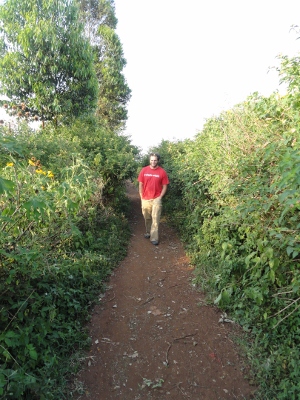 |
| T has a 5 minute commute. Sure beats the beltway! |
 |
| Amani Hospital-Ntagatcha, Tanzania |
 |
| Pediatrics and Maternity wards to the left. Inpatient and Outpatient to the right. |
Tuesday, January 24, 2012
Workout of the day-Tuesday
His:
100 jump squats with w. in backpack (30 pounds)
100 push ups (with w.)
1 minute forward plank (with w.) x5
60 cuban presses (12 lbs)
60 burpees
60 pull ups
100 jump squats with w. in backpack (30 pounds)
100 push ups (with w.)
1 minute forward plank (with w.) x5
60 cuban presses (12 lbs)
60 burpees
60 pull ups
Hers:
20 jump squats
20 reverse sit-ups
10 double under jump rope
repeat for 5 rounds.
J completed in 26 minutes
Sunday, January 22, 2012
Parenting Part 2:
Dawn is so lovely here. In the quiet hours of this morning God has shown me something very important. I see now that my frustration and disappointment over t's behavior and rebellion are evidence that my love for him has in many ways been selfish. My love for him has been for the sake of what I get out of the relationship—for the love I get back from him. This is exactly what Franz Kafka criticized as love that is not really love (and he's right), leading him to dismiss the concept of love altogether. (He was wrong about that).
For the past year, t's behavior has gradually declined. His will has surfaced and his behavior has become more and more difficult to manage. But parenting is not at its core about managing behavior is it?
Years ago a missionary friend told me:
“How I treat my kids and how they treat me, says more to this
community than anything I ever say from the pulpit.” Intuitively I
recognized this as true. But I've been repeating it for years
without really understanding what it means. It does not mean that
the people will listen to me because my kids respect me. It means
loving my kids even when their behavior is atrocious—even when
they
are unfaithful to me—even when I am getting nothing back, or worse
yet, getting frank rebellion in return. Is this not what Our
Father
has done for us? Is this not the best way to show people the
gospel—what God has done for me? He has taken me back and
comforted me and forgiven all that I have done and will do. How
can
I not do the same for t?
Even as I have been writing this, t has been totally unloveable. I stopped writing to make him a nice breakfast at his request. He promptly spent the next thirty minutes screaming, and wailing, and thrashing about because his scrambled eggs were “too big.” I was fairly patient with him, but he just got worse and worse. I gave him a lot of chances but eventually I had to walk away from him. Is he finding assurance of my love by pushing me away with bad behavior and then asking in effect, “Do you still love me?” More screaming. “Now do you still love me?”
I don't know if I'm over analyzing things (perhaps that's my form of comfort). Perhaps he's just having “normal” temper tantrums. But it has certainly caused me to wonder: “What does this reveal to me about how God handles my rebellion and tantrums?
Subscribe to:
Posts (Atom)