Monday, January 7, 2013

Moringa Dilemma


Written by Ty
 

Here's a dilemma for you. Let me know what you think:
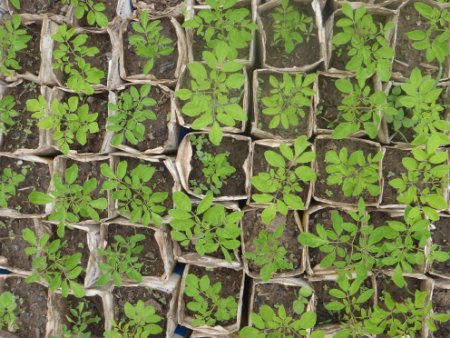
I have tried and failed twice to start seedlings for the moringa tree. The moringa tree is sometimes called “the miracle tree” because its leaves contain the essential amino acids—a providential oddity in the horticultural world. As you may know, legumes contain some amino acids (the building blocks of protein, essential amino acids being the ones your liver cannot make itself so you must eat them) while grains contain a different subset of amino acids, but you must eat a combination of grains and legumes to get all of the essential amino acids that you need. Not true for the moringa tree. Eating the leaves provides a complete protein just like meat does. But growing moringa trees is cheaper, easier, and more sustainable than growing animals for food. All they need is sun and rain. We have plenty of both here. The moringa leaves would a perfect addition to the diet of our children here at City of Hope, as well as the children in the village.

In January I went to great lengths to obtain moringa seeds from a Scandinavian agricultural project in the city 2.5 hrs away. I had to visit them several times in order to procure the seeds. In February, just before the rains, I planted 1000 seeds and left instructions with a friend to water them if they needed it. He did so, but one day the cows got loose and discovered our seedlings. They devoured the tender shoots in five minutes. In August I tried again, this time building a fairly stout fence around them. The rains were again immanent. My friend was away so I left instructions with the children to water the seedlings. When I returned in December: no baby trees. The kids had forgotten to water them. Now I am out of seeds.

Joi had a very good idea. I teach over and over again that it is important to encourage the ideas and initiative of the local people. When the idea is their own, they are much more likely to persevere and carry the plan to fruition. Joi's idea is to gather a group of the boys who are interested in farming and teach them about the moringa tree. Perhaps their desire to grow and become stronger will incite them to take on a moringa project of their own. And then they will be motivated to water them and protect them from animals. I agree. Great idea. That's what I should have done in the first place.

Recently a local nursery owner/farmer brought one of his many sons to the clinic. He was very sick. After bringing him to the hospital he improved dramatically. As a gift to the hospital, the man offered to give us some seedlings—he grows them for profit. We drove to his farm yesterday and discovered a pleasant nursery with thousands of trees of a dozen varieties: coffee, tea, mango, avocado, guava, grevillia, and others—some of them four feet tall. He gave us our choice of 30 trees. I observed all I could and asked many questions. He offered us a price of 12 cents per seedling if we wanted to buy more. I intend to take him up on that in the future in order to do some landscaping. He did not know the moringa tree. I told him about it at length, explaining it would help his many children. I asked him how much he would charge me to raise 1000 moringas until they were 2 feet tall. His price is $70—a steal really—especially given the frustration and failure I have endured thus far. That's seven cents a tree.

So what do I do? Do I strive to somehow incite our boys to start a moringa nursery, with admittedly a fairly high chance of failure and high probability of having to start and restart several times, or do I take the shortcut and get a jumpstart by spending a little money? Of course it would be beneficial to teach the boys to grow seedlings for profit, which they can do for themselves in the future. And even if I get the 2' tall trees, which will probably take a year, I'll still need the boys to plant them, guard them from animals, and nurture them through the transplantation process. But if I rely on the boys' initiative, it may be three years before we finally have 2' tall trees. It's been a year already and we have nothing. They need the protein ASAP. Which will be more profitable: getting them the additional protein as soon as possible by a shortcut which is a pretty sure bet, or investing in their agricultural and business skills and more importantly in their initiative and self esteem by helping them start a nursery—which has a high likelihood of several rounds of failure IF it ever succeeds. I am accepting votes and comments below...

I know, I can do both, but I only have so much time and so much money. I may end up doing both, but want to hear what you think.

Why is a doctor spending time and energy on this? Because a healthy diet, the benefits of a healthy career and income, and a healthy relationship with the land will do more for the children and the community than passing out pills in the clinic will ever do.

Friday, January 4, 2013

January 4, 1997


16 years ago today Grandma Nelson prayed for no snow or storms for our winter wedding and I imagine she prayed for more than that, too. On that day in 1997, a high temperature record of 68 degrees was set in Blacksburg, and still remains today.

At 21 years old we didn't know much about marriage, we didn't know it wasn't all about being happy and in love. We didn't know it would be hard. We didn't know part of the whole thing was to rub against one another's rough spots in order to smooth them out. We did know that giving up was never an option.

We've had adventures all over the world together--and surely our most daring adventure has been our children--I believe all of Grandma's prayers were answered that day.

Thank you for 16 faithful, funny, difficult, never-boring, beautiful, redemptive years. Thank you for never giving up. I love you and thank you for patiently and lovingly sanding down all my rough spots (still a few more to go...)

Happy Anniversary! We didn't forget this time!! ~ Joi


Thursday, January 3, 2013

"OS"


Written by Ty

My New Year's resolution is to be more disciplined about blog entries...

I have actually written several things on paper over the preceeding weeks, but have not committed them to digital format until now. Even this morning, I had to face an array of encumbrances before I could begin to write, though writing was at the top of my to do list on this holiday.

First, I was called to check on a patient at the hospital—an emergency, a young man suffering from a severe asthma attack. When I asked the nursing staff about the medication of choice for his condition, which they had thought of but not yet given, I got my least favorite response: “OS,” she said. Medical professionals in East Africa are even more in love with acronyms than we are. “OS,” means “out of stock.” To my mind this seems a superfluous abbreviation, but who am I to criticize? I am sure they have learned this behavior from Westernized teachers. I am reminded of the professors line in The Lion, the Witch, and the Wardrobe: “My goodness, what are they teaching in schools these days?” In the end, I took some injectable steroids from my personal stock of emergency medications that I keep at the house for our own family's use. The patient now seems to be recovering.

“OS” frustrates me for obvious reasons. How can we be out of life-saving medications for extended periods of time? This is not the first time. These medications are very cheap and available only an hour's drive away. We are supposed to restock our pharmacy weekly. I am sure that we have not used up our whole supply of steroids during the last week—Christmas week, the least busy week of the year. Certainly someone administered the last dose from the pharmacy without ensuring that proper measures were taken to resupply our stock. Of course I could undertake to oversee this process myself, implementing my own system of checks and double-checks, and assess daily as to whether it was being followed, but what would that really accomplish? As soon as I am away then it won't get done. The idea to deal with this problem and the discipline to carry it out must come from the nursing staff—not from me. If I teach someone algebra, they will never learn it if I do all the problems for them. I must let them do the problems themselves. The same applies to teaching medicine. Admittedly, medical care can be high stakes. People can die if we don't make the right decisions. And sometimes those decisions have to have been made a week ahead of time. We have our challenges...

After that emergency, I had to investigate why the solar power was down, which led my computer to be dead. J's computer still has battery power, but I first had to repair the Tab key, which little W. tore off. Actually she ripped off many of the keys—all but the Tab key just clicked back in place. But the Tab key was actually broken. I also had to have a discussion with Dr. C. trying to discover why the workers we had hired to dig a cistern (a REALLY huge hole in the ground in which you could hide a school bus, which they dig with two shovels, a bucket and a rope) had run off. On one level I don't blame them...

A Wild Trip to Kenya Continued


Written by Ty

The view from our final destination.

Also bear in mind that it turns out that little W gets car sick easily. She's never had this problem in America, but she has had it here before. Come to think of it, I get carsick pretty easily here if I'm not sitting in the front. Anyway, she puked the whole way there and the whole way back. J moved into the back to try to catch it in a pitcher, but only rarely actually managed to contain it. Fortunately, W was a good sport about it. Despite the fact that she was vomiting, she wasn't crying. She mostly just slept. Then she woke up for five minutes, asked for a snack, didn't get anything, puked again, and then went back to sleep with her head on mommy's lap.


As I reported above, the next five hours to Eldoret were “fairly uneventful.” We stopped and bought “lunch” though it was 3PM. It was actually “pizza.”  Unfortunately my expectations were too high because I had been told by an American friend that the pizza there was “not bad.” I think he was just really hungry and roadworn the day he made that assessment. The sauce was Kenyan “ketchup” which I don't like in the first place. I would probably have left it on the table and gone somewhere else had I been in America, but I was starving and short on time and mostly having any cheese whatsoever was such a treat that I ate it pretty happily. We picked up another amazing treat—real butter—at a grocery store (our friends have a fridge and it was Christmas after all) and got back on the road by 4PM, hoping to arrive well before dark at 7PM.

Another part of the agenda that didn't go as planned...

I bought diesel and at the station inquired as to the road to Iten, which I assumed was a small village along a dirt road to our friends' town. The attendant assured me (in good English) that it was the next blacktopped left turn off the main road. I took that turn, but just to be sure, I asked two other people along the road if this was in fact the road to Iten. Both said yes. At least at the time I thought they said yes. Those conversations were in Swahili.

I learned two lessons over the next two hours wandering over bumpy unmarked dirt roads. Both of them I knew already, but things had been going so well that perhaps I had a false self assuredness. The lessons are: 1) Remember when asking directions of random people along the road, that they almost certainly do not drive—hardly anyone in Africa owns their own car. So if they don't drive a car, they probably don't think in a way that helps to give directions to a car 2) I know just enough Swahili to be dangerous...

I could tell by the sun we were headed due north—the right direction, which only added to my self assuredness. The “next turn” indicator at the top of the GPS screen said “continue to unpaved road,” which is pretty much what it always says. But after an hour, it seemed something was wrong. The road was getting narrower and less well traveled and there were forks in the road that my directions said nothing about. I started asking directions again and discovered that we were definitely on the wrong road. After talking to four or five different parties, I got directions that I thought would probably actually take me to Iten, but we still had a ways to go after that. My new directions led me to a paved road—the right road to Iten. It turns out the road it Iten is paved, and that we could have been there in 20 minutes if we had taken the right turn. Furthermore, when I reached the road to Iten, I was back to within 3 miles of where I had made my original wrong turn. We had driven two hours on a bad road in a big circle! The map below shows a track taken from our GPS data which reveals the details of our wayward detour.


 We arrived in Iten after 20 minutes. It was now 630 and getting dark. Iten, by the way, is situated at 7000ft and is located in the area occupied by the Kalenjin tribe of Kenya. Iten is home to a high altitude training camp for marathon runners who come from all over the world. It is strange to see Europeans, Asians, many Africans, and others—mostly in skimpy running shorts, which you don't see in Africa—loping alongside the road in this small African town. When you enter the town, a banner over the road proclaims “the home of champions.” This is because while Kenyan's have dominated distance running worldwide for five decades, winning more medals at major events than any other country, over 40% of the Kenyan runners who have won these honors have been from the Kalenjin tribe. The are sometimes called “the running tribe.”

We still had 2 hours on the dirt, which we were not enthusiastic about at this part. Except that I drove it a little on the fast side just because we all wanted to get there so badly and this lead to perhaps a bit more spitting up than we would have otherwise had to tolerate, this passed without further difficulty. We arrived well after dark, but we were safe, happy and delighted to be with our friends. 


Tuesday, January 1, 2013

A Wild Trip to Kenya


Last week we traveled to to Kenya visit Dr. Aaron and Sonya J., friends who have just begun a two year stint at a mission hospital in Western Kenya. We hoped to go there to enjoy Christmas with them, to encourage them in their new work, and hopefully to help them adjust to some the of challenges of being new to Africa.

Kenya is close—I can walk there. But that's just the border. These folks are at a fairly remote location 241 miles to the north. 241 miles is much farther in Africa than it is in America. I would not have even undertaken the journey except that: most of the road between here and there is paved and I have a new GPS with Africa maps which would help us find the way. This device was immeasurably helpful. I have used it for 3 weeks now, and I have over and over again been amazed at the small muddy “roads” that are actually in its database. However, none of these roads have real names, and the GPS has no way of predicting the condition of the roads: whether there is impassable mud, whether a huge truck has jack-knifed and blocked the entire road for weeks, or whether the most direct route is in fact three times slower than a more roundabout route. If you have ever been misled by a GPS in America, then take that experience and its annoyances and consternation and multiply that by about a thousand, and then you have the situation that a GPS might lead you into here. After all, they can't think. They carry only data—no knowledge and certainly no wisdom. It would certainly be a mistake to have too much faith in the GPS. That would be a case of the dim-sighted following the blind and overconfident. For example, when you input a destination into the GPS—and yes, we sometimes actually type in coordinates including minutes and even seconds—it confidently displays an arrival time in the lower left hand corner, the same as in America. Here, you might as well triple the driving time and then add three hours. Then assume that you have about a fifty-fifty chance of arriving within three hours of that time. It all depends on things like: how good are your tires and battery? Do you have a spare? Do you have two? Is it raining? Is it a holiday? Who maintains your vehicle? Do you have proper paperwork for the police checks? And on and on. So I just change the settings to display elevation in the lower left hand corner, because that is somewhat interesting and is at least true. We reached as high as 8300 ft on this trip.

It's 241 miles to where our friends are working. We left at 6AM (dawn), hoping for an eight hour driving time (based on data combed from locals): Forty minutes on our dirt road, two hours to Kisii on the blacktop (50 miles), three and a half more hours to Eldoret (120 miles), and then another 2 hours more on dirt to finish the trip.

That's not how it turned out...

At 1030AM, we had only covered 14 miles. Only five miles from City of Hope, our fan belt broke. Ironically, the manager here had told the mechanic to replace it only a few days before, but the mechanic had insisted that it still had plenty of life in it. Fortunately we were able to limp into town. Having got such an early start, we had to wait for the “spares shop” to open. It was December 22, too close to Christmas for it to open on time. Everything gets slow here around holidays. The first shop didn't have the belt. The second one did when it finally opened. My friend helped me locate a mechanic who agreed to replace it for less than four dollars. I could have done it myself, but figured that four dollars was worth it. We still had to go through immigration and customs and do lots of paperwork so I figured I could do that while he fixed the car. I was encouraged in this delusion by how cleverly he removed the other belts from the engine—something I wouldn't have thought of. He jacked up the rear end, put a screwdriver between the pulley and the belt that needed to be removed, and had his accomplice turn the back wheel of the truck with the transmission engaged in fifth gear. The engine crawled forward and the belt popped off—rather than having to remove the power steering pump to get it off. I thought, “That's a good trick. This guy knows what he's doing.” I left the truck in his hands, with my friend there to oversee and report in on the progress, and headed to the immigration office. I'm really not that much of an optimist, but I also didn't really have much choice. It was now about 9AM.

Customs was its own fiasco. I don't even really understand what happened with the paperwork for the truck, but eventually they let me through—really they were just letting the truck through.

Immigration should have been simple. We already had visas, and usually this is a pretty quick process—they have seen me plenty of times before. But on that day the line was LOOOOONG. Hundreds of Tanzanians were cued up to reenter Tanzania for Christmas. They were coming from well paying jobs in Kenya. Or the other way around. This is a small border crossing and one desk serves for entering the country, exiting the country, applying for a visa, or any other purpose. In order to prevent people from cutting in line, the African method of standing in line is often to stand with your chest firmly pressed against the back of the person in front of you—a total stranger. You enjoy the same treatment from an unknown personage standing behind you. Of course there's a fifty percent chance that each of those people will be of the opposite gender. It's a little tough to get used to—especially in the hot sun. I was able to tolerate it for just long enough to survive the line. When I finally reached the front, the haggard official waved us through with hardly a glance at our passports. We were only people in that substantial line that actually had passports as far as I could tell.

Of course the truck, for reasons I didn't even bother to ascertain the details of—something about the first belt not being the right one, was not ready, even though an hour and a half had gone by. I took advantage of the “extra time” to take a risk. My stomach was growling so I was getting grouchy by this time. Accordingly I hazarded to partake of some street food, a not insignificant gastrointestinal gamble when you have an eight hour drive without a single nice bathroom ahead of you, but being hungry is no fun either. So I bought a chapati (flatbread) and hot pinto beans served in a flimsy polyethylene bag with no utensils. I know you are somehow supposed to be able to get the piping hot beans out of the bag (the size of a sandwich bag, but about as sturdy as wet tissue paper) and into your mouth with the flatbread, but not being raised that way, I'm not really capable. It wasn't pretty. By 1030, we were finally underway again.

The next five hours were fairly uneventful. We tried to stop to use the bathroom in sugar cane or corn, both of which are basically tall and dense enough to hide you. Though rural, the area we traversed is fairly well populated and there are people everywhere along the tarmac road. I say it was uneventful. Except for this: If my mother could see the kind of wild passing a driver (OK, me) is basically forced to undertake if he wants to get anywhere in a reasonable amount of time, she would forbid me to ever drive in Africa. (Yes mom, I know you're reading this, but you're going to have to let me be an adult and make my own decisions on this. When you come visit we will avoid taking any long drives on the “highway” and we will just be satisfied with forever traveling at a tractor's pace—we can even take the tractor to town if you want, but it has zero suspension). The problem is that there are two narrow lanes (barely), one in each direction, and there are all kinds of traffic on them, each with its own pace. I will endeavor to describe the assemblage in order of rate of travel: Cows (a blundering quadruped ran into us twice—I was not moving I promise), sheep, pedestrians, oxen pulling plows tied to a slab of wood as a “trailer,” tractors (usually with six to infinity passengers and pulling a jalopy trailer of some type), 100cc Chinese motorbikes that can only make 25mph with three (or six!) passengers on board or better yet with ridiculous cargoes like 8 sheets of plywood, 30 stackable chairs, three 20 ft. ladders, 80 chickens or even a 55 gallon drum full of gasoline (yikes!), matatus (minivans) with up to 30 people in/on them necessarily with half of them standing on running boards or bumpers or clinging precariously to the roof (you still pay full fare though) also with a bedazzling array of cargo stacked in towering configurations, buses of various sizes (some with goats tied on the roof and some not—the same thrilling loading methodology used for all vehicles—I actually witnessed a stack of mattresses collide with powerlines at 50mph on this trip), “lorries” (which are also insanely overloaded with up to twice the load that an American semi would be allowed to carry) that lumber down the road with absolutely terrifying authority giving quarter to no fellow traveler (SERIOUSLY, you had better yield), and lastly a smattering of private cars all trying to pass one another in the melee. Suffice it to say, I held my own, but I scared myself more than once. It takes vigorous attention and concentration. Not once, but twice (I honestly regret them both, I won't do it again mom), I passed a vehicle by driving on the shoulder (far from paved) on the opposite side of the road, with oncoming traffic passing between me and the vehicle I was overtaking. I apologized to the wife and kids afterward—both times. But please bear with me in grace, bearing in mind that I have to drive on the left while sitting on the right hand side of the truck and a 100yd stretch of road with no potholes is non-existent. There is a reason that nearly all drivers in Africa are professionals. It is not for the unpracticed or feint of heart (or will).

To be continued...